Something happened when you saw this. What was it?
Abstract Inquiry · 2026
Structural Emergence
On white's insistence, and the art of what survives noise
Available · in the studio, Phoenix
White that insists on itself — the structure that arrives from the surface rather than being placed onto it.
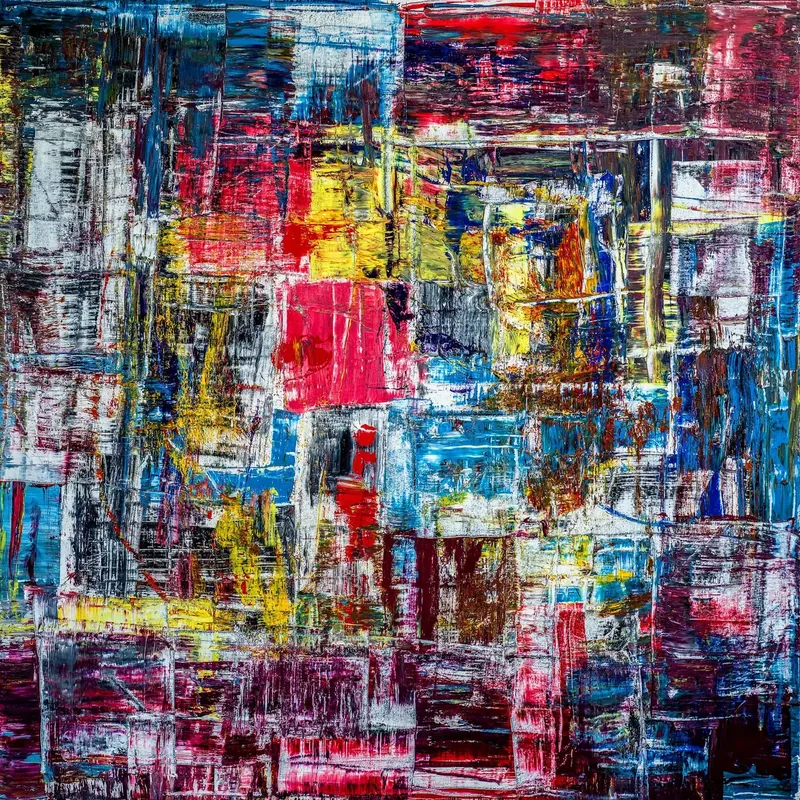
There is white in this painting that refuses to stay buried. Not as ground. Not as light source. As argument.
Structural Emergence began, as many paintings do, with a question I couldn't quite articulate. I layered reds, blues, ochres — kept building until the surface became geological, almost sedimentary. Color pressing against color. And then something unexpected happened: white began to show through. Not the white I had put down at the start. Something older. Something that had been waiting.
The painting is built on a tension that is architectural before it is painterly. The verticals and horizontals — never quite a grid, never quite free — create a scaffolding that holds the chromatic noise in place even as it seems to vibrate. Structure, here, is not the enemy of feeling. It is the condition for it.
Four painters in the room
Gerhard Richtertaught me something about the politics of the squeegee — how dragging one layer across another is an act of partial erasure that paradoxically reveals. In Structural Emergence, the Organic Movement technique — string and thread replacing brush — performs a similar logic. Each pull of thread through wet paint opens channels. What was beneath becomes suddenly, briefly, visible. Richter works with photographic memory and its dissolution; I work with color's weight and what insists on surviving it.
Willem de Kooningnever fully left the figure, even when he appeared to abandon it. That ambivalence — figuration pressing through abstraction like a memory the painter can't quite release — has always interested me. In this painting, white performs a similar haunting. It is not a form. But it behaves like one. It has intention.
F.N. Souzabrought a particular chromatic ferocity to his canvases — reds and blacks that felt like wounds, surfaces that held violence and beauty in uncomfortable proximity. Growing up around my father's criticism of that generation of Indian modernists, Souza's urgency became part of how I understand color as an ethical force, not merely an aesthetic one. The hot reds in Structural Emergence carry some of that pressure.
J. Swaminathanis the quietest influence here, and perhaps the deepest. Where Souza burned, Swaminathan listened. His paintings have a stillness beneath their surface complexity — a sense that the image is not imposed but discovered. That quality of discovery, of a painting revealing rather than declaring itself, is what I was reaching for. White in Structural Emergence is not placed. It emerges. Swaminathan would have understood that distinction.
What light demands
There is a question I keep returning to in the Abstract Inquiry Collection: what persists when everything else is noise? The answer, in this painting, is structural. It is the thing that was always underneath — patient, insistent, not particularly interested in being dramatic about its arrival. White doesn't announce itself in Structural Emergence. It simply becomes undeniable.
Structural Emergence is acrylic on canvas, 60 × 60 inches, part of the Abstract Inquiry Collection.
Where to see it. In person at RituStudio, Phoenix, by appointment. Represented by Jarrow & Goodman, Los Angeles.
The space it needs
- Wall
- At least 8 ft wide
- Ceiling
- 9 ft or more
- Light
- Natural light preferred — oil layers shift through the day
- Daylight
- White insists here, and white holds steady in any light; the teal and navy stay put, with only the copper and coral pink warming in late sun. Raking light brings the textured structure forward.
Lives best in
Living room 5/5
Structural Emergence earns a 5 here because a living room is where people return repeatedly, and this painting rewards exactly that, its white pressing up through charcoal and smoky red differently at noon than at dusk.
Hotel lobby 4/5
The five-foot canvas commands a lobby wall without overwhelming transit traffic, and the teal and copper give arriving guests an immediate focal point that reads as sophisticated rather than challenging.
Details
- Size
- 5 × 5 ft (W × H)
- Medium
- Oil on canvas
- Year
- 2026
- Collection
- Abstract Inquiry
- Palette
- Charcoal Gray · Graphite Black · Lilac Gray · Smoky Red · Teal · Copper · Muted White · Coral Pink · Navy
- Weight
- About 45 lb
- Ready
- In the studio; delivery 8–12 weeks
Its ArtGram
ArtGram.Quatrefoil
- Texture4
- Form2
- Colour range4
- Palette3
- Contrast4.4
- Abstraction Quotient4.5