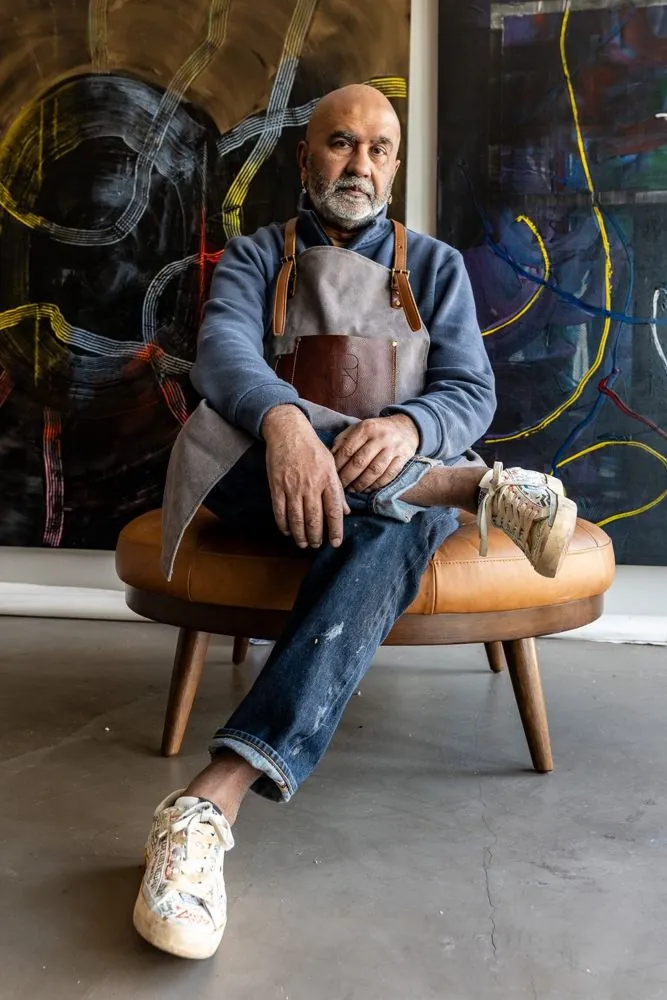
Ritu Raj — Painter, Author and Entrepreneur
The Ground
and the Engine.
Ritu Raj prepares the ground and waits for abstraction to arrive. His paintings hold movement, emotion and the physics of their own making: form given to what is felt before it can be named.
“I don’t paint to mirror what is seen, or give form to what is felt. I prepare the ground, and wait for what arrives.”
I don’t enter the studio to express something. I enter because something is already forming, beneath thought and before language, and the canvas is where it becomes visible.
My practice moves between two bodies of work. Organic Movement releases thread across wet paint, surrendering to gravity and viscosity; the marks carry physics inside them. Abstract Inquiry is slower, more interior. I sit with a canvas until it signals what it needs. Then I respond.
I am the ground from which the work arises: a childhood inside Indian modernism, a life of building at the edge of what is possible, and a practice that refuses to separate thinking from making. The same inquiry moves through the paintings, through ArtGraph, and through the books, where I try to say what the canvas already knows.
The paintings are not meant to be solved. They are meant to be lived with, returned to as you change, and found to have changed too.
About the artist
Ritu Raj is an American painter, author and entrepreneur based in Phoenix, Arizona. He builds, he paints and he writes from a single source. He founded Avasta, one of the pioneering cloud computing companies, and Wag Hotels, and helped build SideCar, an early ride-sharing platform, and Diamond Foundry, the lab-grown diamond company. He grew up in New Delhi among the modernists his father, the critic K.B. Goel, wrote about, Souza, Husain and Swaminathan among them. His signature technique, Organic Movement, replaces the brush with thread; alongside it, the Abstract Inquiry series turns inward. He has made more than 250 paintings, represented by Jarrow & Goodman in Los Angeles and collected across the US, Europe and Asia. He is the creator of ArtGraph, a language system for encountering abstract art, and the author of The Shape of Seeing and The Unalgorithmic Self, both from American Real Publishing.
Art that listens.
The years
- 2020
Beginning again
Began painting in San Francisco during the pandemic lockdown, picking up a thread that runs back to a childhood among India’s modernists.
- 2021
Scale and atmosphere
Large-format 6 × 6 ft paintings; the Ephemeral Atmosphere series begins.
- 2022
Phoenix, RituStudio
Moved to Phoenix and RituStudio, an 1,800 sq ft studio and gallery. Painting 9 × 9 ft canvases on the floor.
- 2023
Form, texture, expression
Completed the Out of Darkness series. Solo show at Chez Cheese; four of nine paintings sold.
- 2024
Organic Movement
Developed the thread-painting technique, Organic Movement. Completed the Black & White series and opened the studio with the solo show Dreaming in Black & White.
- 2025
Representation
Represented by Jarrow & Goodman, Los Angeles. String Theory solo show and Shroomphoria group show. Pop Art series on CNC-cut wood.
- 2026
Language and recognition
LA Art Show and Scottsdale Art Week with Jarrow & Goodman. Built the Taxonomy of Abstraction and ArtGraph. The Shape of Seeing and The Unalgorithmic Self published.
Shows and exhibitions
- LA Art ShowLos Angeles Convention Center · Jarrow & GoodmanArt fair, 2026
- Scottsdale Art WeekScottsdale, ArizonaArt fair, 2026
- String TheoryJarrow & Goodman, Los AngelesSolo exhibition, 2025
- ShroomphoriaJarrow & Goodman, Los AngelesGroup show, 2025
- Pop ArtHawk Salvage, PhoenixGroup exhibition
- Dreaming in Black & WhiteRituStudio, PhoenixSolo exhibition, inaugural studio show, 2024
- The Newton NarrativesArtlink, PhoenixJuried exhibition
Press
- ArtsyJarrow & Goodman presents String Theory →
- CanvasRebelMeet Ritu Raj →
- Digital JournalFull-time dedication to abstract painting →
- Artist HighlightThe Organic Movement series →
- Artist CloseupInterview with Ritu Raj →
- Authority MagazineIn conversation →
For interviews, photographs and bios, see Media.
What collectors say
“My wife and I were immediately drawn to Ritu’s work. He walked us through his studio and guided us to some pieces. Incredible professionalism getting them to our house. 10/10 experience.”
“Definitely advise a whirl through Ritu’s studio. From stark blacks and whites to vibrant pastel pop, he creates energizing contemporary abstract pieces that catch the eye.”
“Stunning, spectacular and inviting. Ritu’s art and studio are each a masterpiece in their own right.”
Questions collectors ask
Collecting
Why should I collect abstract paintings by Ritu Raj?
Ritu’s work sits at a rare intersection: the lineage of Indian modernism, Souza, Husain and Swaminathan, meeting the experimental tradition of Rothko, Pollock and Hilma af Klint, filtered through a mind that has built category-defining companies. The paintings are not decorative objects. Each is a record of process, philosophy and form that cannot be replicated. Collectors across the US, Europe and Asia have recognised that early acquisition of a body of work this distinctive carries both cultural and long-term weight.
What does it cost to collect original work by Ritu Raj?
Original paintings, oil on canvas and acrylic on canvas, are priced between $10,000 and $15,000. They are large-format works, many 6 × 6 ft or larger, made in a dedicated studio practice with full exhibition history and provenance documentation. At this price you are acquiring a serious original at the beginning of a career that is already gallery-represented, internationally collected and critically documented.
Will the value grow over time?
No one can guarantee appreciation in art, and anyone who does is selling something other than art. What can be said plainly: the work is gallery-represented, shown at major art fairs, collected across three continents, and made as a disciplined body of originals with no prints or editions. The same practice has built four category-defining companies, which gives the paintings unusual cultural weight at this price. The conditions for long-term value are present. Whether and when the market moves is its own question.
How do you choose one painting from a catalog of 250+?
Colour and size narrow a search; they do not end one. The harder question, the one that actually decides a wall, is how a painting meets you: what it does in a quiet room, whether it holds you or hurries past, what feeling it leaves once the novelty wears off. Every work in the catalog is mapped not only by texture and palette but by emotional register and the kind of encounter it creates, so the question shifts from which one looks right to which one is for you.
Do works come with provenance documentation?
Yes. Every work comes with a certificate of authenticity signed by the artist, documenting title, medium, dimensions, date and edition status (all originals; no prints). Provenance records are kept for each work and are available to collectors and institutions on request. Exhibition history, including the LA Art Show, Scottsdale Art Week and RituStudio shows, is recorded and transfers with the work.
What size works are available?
From 3 × 3 ft up to a monumental 9 × 9 ft. Many collectors begin with a smaller piece and return for scale. The largest works are painted on the floor and built to hold a room, shifting with the light through the day. A studio visit is the best way to judge scale; dimensions on a screen rarely prepare you for a nine-foot canvas.
How are works shipped?
Every work ships professionally packed, insured and tracked. Large canvases are crated for transit, and international deliveries go with specialist fine-art shippers. The paintings have travelled to collections on three continents without incident.
Where can I see the work in person?
At RituStudio, an 1,800 sq ft studio and gallery in Phoenix, Arizona, by appointment: an unhurried hour with the work and the artist. Ritu is represented by Jarrow & Goodman in Los Angeles, where the paintings have been shown at the LA Art Show and in solo and group exhibitions.
The work
What makes the technique unique?
Ritu’s signature technique, Organic Movement, releases thread, not a brush, across the canvas, surrendering to gravity, viscosity and momentum. The result is mark-making no hand could fully choreograph. Some works are built on CNC-carved wood panels, where the sculpted surface becomes part of the composition and the line between painting and relief dissolves. The technique is wholly his own: documented, exhibited and collected as a distinct contribution to contemporary abstraction.
What is Organic Movement?
Organic Movement is Ritu’s signature technique, and a philosophy before it is a method. Thread replaces the brush. Paint is released into gravity, viscosity and the tension of fibre dragged across canvas. The artist sets the conditions; the work completes itself. The line carries physics inside it, taut, weighted and alive in a way no brushstroke can repeat. Every Organic Movement painting is, in the truest sense, unrepeatable.
What is Abstract Inquiry?
Abstract Inquiry is Ritu’s second body of work, slower and more interior than Organic Movement. The process is one of listening: sitting with a canvas until it signals what it needs, then responding. The paintings, oils and acrylics, often large, are built on questions about perception, memory and form; Bands of Tension, Fragments of Thought and Mapping the Unseen all belong here. Influences include Rothko, Hilma af Klint and Clyfford Still. The work does not illustrate ideas. It enacts them.
What is the Taxonomy of Abstraction?
The Taxonomy of Abstraction is Ritu’s framework for reading an abstract painting: a way of describing what a work is and what it does to the person standing in front of it. Six dimensions describe the painting itself: texture, form, colour range, palette, mood and its Abstraction Quotient. Three more describe the encounter: the space a work asks for, the way it transforms a room, and the feeling it leaves behind. It is the vocabulary beneath everything here: the catalog, the writing and the discovery tools.
What is Find Your Painting?
Find Your Painting is a conversational way to discover Ritu’s paintings. Rather than scrolling a grid, you describe what you are drawn to, a feeling, a room, a question you are sitting with, and it surfaces the works that meet it. It does not sell; it listens, then points. Built on the same framework as the Taxonomy, it is the closest thing to walking the studio with Ritu when you cannot be there in person.
What is the thinking behind Ritu’s books?
Two books extend the questions the paintings ask. The Shape of Seeing explores the genesis of abstraction: how the eye, the mind and the hand conspire to make form from feeling. The Unalgorithmic Self addresses what is irreducibly human in an age of artificial intelligence: intuition, experience, the kind of knowing that cannot be trained. Both grow from the same ground as the paintings, a refusal to separate thinking from making.
Visit the studio
RituStudio, 3502 East Onyx Avenue, Phoenix. By appointment.