Available now · Ritu Raj
The Unalgorithmic Self
Art, AI, and the Future of Human Thinking
Thirty chapters on the body, emotion, memory, imagination, uncertainty, love, ethics and art: the dimensions of selfhood that no machine can replicate. A book about preserving the human soul in the age of artificial intelligence.
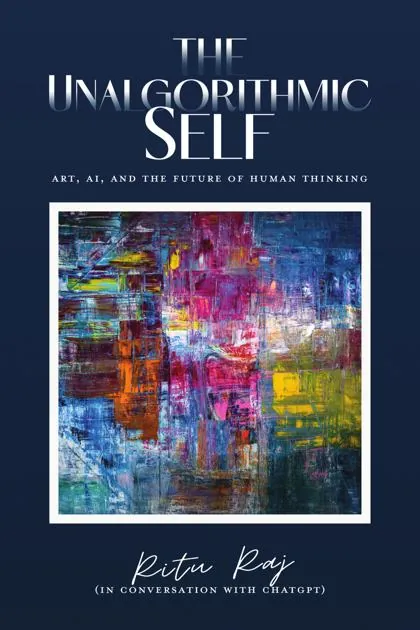
- Publisher
- American Real Publishing
- Published
- September 29, 2026
- Paperback ISBN
- 979-8-90447-029-6
- Hardcover ISBN
- 979-8-90447-030-2
- Kindle ASIN
- B0HL9VT148
- Library of Congress
- 2026920104
- Editions
- Hardcover · Paperback · Kindle
- Structure
- 30 chapters · Conclusion · Afterword · 6 parts
- Companion volume
- The Shape of Seeing
A machine can answer a question.
Only a human can wonder.
A machine can generate a story.
Only a human can live one.
A machine can predict a pattern.
Only a human can break one.
A machine can process the world.
Only a human can feel it.
That line is the self. This book is a return to it.
Where the book began
We already live in an algorithmic world.
The shows we watch are tuned to pull on our emotions. Even the toothbrush in your bathroom was probably sold to you by an algorithm.
So where do we come in? What becomes of the soul, the heart, and, at the end of the day, love?
That question became The Unalgorithmic Self.
From the pages
“A profile may approximate your tendencies. It can’t contain your becoming. A model may predict your next click. It can’t witness the quiet moment when you decide to change.”
A machine can produce a sentence about grief without having lost anything. It can write about love without having risked anything. That gap is everything, and it’s exactly the gap this book is about.
What I’ve noticed, in myself, in conversations, in our wider culture, is a slow drift toward measuring human beings the way we measure systems: speed, output, consistency, accuracy, performance. And by those measures, yes, machines exceed us in domain after domain.
But a human life isn’t lived in domains. It’s lived in what I can only call the thickness of time.
“To be human is to step into the unknown with courage. To stay human is to keep the unknown open.”
“Machines know patterns. Humans know meaning.”
“What ought never be automated is anything that requires a self to answer.”
The author
Both sides of the line.
“My insight, earned, not theorized, is this: machines don’t threaten what makes us human. Forgetting ourselves does.”
Ritu Raj is an American painter, author and entrepreneur working from RituStudio in Phoenix, Arizona. His signature technique, Organic Movement, sets the brush aside and works the paint with thread, leaving a striated relief that changes as you move past it.
Born in New Delhi, he grew up among India’s modernists, Souza, Husain, Raza and Swaminathan, through his father K.B. Goel, one of India’s preeminent art critics. His mother, a professor of English literature, taught him to listen to the silence between words. One gave him form; the other, meaning.
Mathematics and computer science became another grammar for the same question, and three decades of building companies tested it at scale: he founded Avasta and Wag Hotels and helped build SideCar and Diamond Foundry. The painting, the writing, and ArtGraph, his language system for encountering abstract art, are one inquiry held in different materials.
That is why this book could be written from inside both worlds at once: computation and optimization on one side; paint, string, silence and embodied thought on the other. The Unalgorithmic Self is the companion to The Shape of Seeing.
More than 250 paintings, collected across the US, Europe and Asia. Represented by Jarrow & Goodman, Los Angeles.
- Avasta
- Founder · an early cloud computing company
- Wag Hotels
- Founder · pet hotels, grown to nine locations
- SideCar
- Product · an early ride-sharing platform
- Diamond Foundry
- Corporate development · lab-grown diamonds
- ArtGraph
- Creator · a language system for encountering abstract art
- RituStudio
- 1,800 sq ft studio · Phoenix, Arizona
- The Shape of Seeing
- Available now
- The Unalgorithmic Self
- Available now
Contents
A map of the interior.
Part I · Chapters 1–9
The Human Interior
- 1The Unalgorithmic Self
What it means to remain human — and why machines can’t be selves
- 2The Body and the Ground of Being
Embodiment as the basis of all meaning — Merleau-Ponty
- 3Emotion and the Making of Meaning
Emotion as intelligence, not interruption — Nussbaum
- 4Memory as a Living Reconstruction
Why memory isn’t storage — and why machines can’t remember
- 5Imagination and the Human Future
Rupture over recombination — Arendt’s natality
- 6Identity as a Story, Not a Category
What algorithms see, and what they will never see
- 7Abstraction as a Human Art
Why the abstract painter does something no model can
- 8Embodiment and Perception
Perceiving from within — vs. processing from outside
- 9The Sense of Reality: Attention, Presence, and the World That Arrives
Attention, presence, and what simulation quietly erodes
Part II · Chapters 10–15
The Interior and Intelligence
- 10Why Machines Cannot Think Like Us
Thought as lived integration — not pattern completion
- 11The Sacred and the Unquantifiable
What metrics can’t touch — and what vanishes when they try
- 12Consciousness and the Inner Light
The irreducible “someone” behind experience — Heidegger
- 13Vulnerability as the Essence of the Self
Why only what can be hurt can truly love — Levinas, Jonas
- 14The Collapse of Uncertainty: Why Predictability Threatens Human Freedom
Prediction as a threat to freedom, creativity, and becoming
- 15The Soul in the Age of Intelligence
Soul as depth, not complexity — what no system can enter
Part III · Chapters 16–19
The Unfolding Self
- 16Returning to Ourselves
The drift away from interiority — and the return that begins with recognition
- 17Depth in a Shallow Age
How algorithms compress complexity — and what to protect
- 18The Practice of Being Human
Presence, feeling, remembering and choosing — a daily practice, not a fixed identity
- 19Time, Aging, and the Evolving Self
Time as the medium of becoming — how meaning ripens through change
Part IV · Chapters 20–23
Relationships, Responsibility, and the Other
- 20Ethics in the Age of Intelligent Systems
Ethics as imaginative responsibility, not compliance
- 21The Moral Limits of Algorithms: What Ought Never Be Automated
Why moral accountability can’t be delegated to systems
- 22The Face of the Other: Ethics Beyond Algorithms
An ethical demand no algorithm can generate — Levinas
- 23Human Relationships in an Algorithmic World
Attention and risk, and how to protect them
Part V · Chapters 24–28
Creativity, Culture, and Meaning
- 24Love in the Age of Algorithms
Why love resists optimization — transformation, not matching
- 25Creativity as the Movement of the Inner World
Interiority moving outward, through risk, mystery and attention
- 26Culture, Belonging, and the Human Story
Shared meaning across time — an inheritance, not content
- 27Art, Interpretation, and the Human Imagination
Art as a meeting between inner worlds
- 28Language, Meaning, and the Space of the Human
Language as world-making — presence beyond fluent output
Part VI · Chapters 29–30 · Conclusion · Afterword
Human Futures
- 29Human Futures: Choosing How We Live with AI
What we choose to protect in ourselves and in each other
- 30The Unalgorithmic Self
The strands gathered into one name: presence, meaning, freedom, depth
- 31Conclusion: The Future Belongs to the Human Interior
Why progress without depth produces a hollow civilization
- 32Afterword
A charge to tend the inner life
In conversation
Questions, answered.
What inspired you to write The Unalgorithmic Self?
A question I could not ignore: what does it mean to remain fully human in an age shaped by intelligent machines? When AI entered mainstream culture, the conversation split into promise or threat: productivity, replacement, disruption. Somewhere in that noise, the human question was being quietly lost. The rise of AI is more than a technological event. It is a mirror. It asks us what intelligence, creativity, emotion and meaning actually are, and finally what a human life is.
Is this a book against AI?
No. It is a book about remembering ourselves. AI is extraordinary, and it will reshape our world. It can assist with knowledge, reveal patterns, and support creativity. But a tool cannot become the source of meaning. My claim is simple: machines don’t threaten what makes us human. Forgetting ourselves does.
What is the “unalgorithmic self”?
It is my name for the part of human life that refuses reduction. It isn’t mystical. It’s ordinary, and that is its power. It is the fact that your life has an inside: sensation becomes experience, experience becomes memory, memory becomes identity, identity becomes responsibility. A profile may approximate your tendencies, but it cannot contain your becoming. A model may predict your next click, but it cannot witness the quiet moment when you decide to change.
You are a painter. What does art have to do with artificial intelligence?
Everything. Abstraction is one of the oldest human capacities. Before it can interpret the world, the world must first touch us. A painter standing before a landscape feels space, light, temperature, memory and mood, and distills that encounter into form and color. A machine has no encounter to distill. It can generate images, but not impressions. In the studio I learned that painting is less about producing images than about constructing attention. That is exactly what this book is trying to protect.
What do you hope readers carry with them?
That the future isn’t asking us for efficiency. Efficiency will come. It is asking for depth: the courage to stay inwardly alive, the wisdom to decide what should never be automated even if it can be, and the rare gift of being fully here. It begins in small choices: whether you pause before reacting, keep a place for silence, and risk real relationship instead of curated contact. The future needs humans who remember how to be human.
Listen
The author, in conversation.
- Podcast · The Digital Executive · Episode 1342Keeping Humanity Alive in the Age of AI Listen →
- Coruzant · ProfileRitu Raj: Insights from The Unalgorithmic Self Read →
More interviews and press on the media page.
Philosophical companions
Thinking together across time.
- Heidegger1889–1976Dasein · Being-in-the-world
Human existence is not a mind floating above life but an embodied presence immersed in time, care, and relationship. We are the beings for whom existence is always already at stake.
- Arendt1906–1975Natality · Action · Plurality
What defines humanity isn’t intelligence but the capacity to begin: to initiate something whose outcome cannot be predicted. Every person enters the world carrying the possibility of the unprecedented.
- Levinas1906–1995The Face · Ethical summons
Ethics does not begin with rules but with encounter: the face of the Other that calls you into responsibility before you choose it. Machines can detect faces. They cannot be addressed by one.
- Nussbaum1947–Emotions as intelligence
Emotions are not noise in cognition but forms of evaluative judgment. Anger recognizes injustice. Grief recognizes the depth of love. To suppress emotion is not to think more clearly; it is to think less humanly.
- Merleau-Ponty1908–1961The body as first interpreter
“The body is our general medium for having a world.” Perception is not passive reception but an active encounter between a vulnerable organism and a world that presses back. We do not have bodies. We are them.
- Hans Jonas1903–1993Vulnerability · Responsibility
As technology extends our power, our ethical obligations must deepen to match it. Responsibility arises from fragility: wherever something living can be harmed, a moral demand appears. Machines cannot feel that demand.
A note on process · from the Preface
“One thing must be said plainly, because it matters here. Portions of this manuscript were developed in conversation with an AI language model.”
This was not a ghost-writing arrangement. The ideas, the philosophical direction, the lived questions, the values, the inner urgency: those are mine. The tool served as a responsive surface: sometimes clarifying, sometimes challenging, sometimes accelerating the craft of articulation.
The irony is real. So is the authenticity.
Because the unalgorithmic self isn’t defined by refusing tools. It’s defined by not surrendering the interior world: by remaining the author of meaning, the bearer of responsibility, the keeper of what can’t be reduced to computation. That collaboration isn’t a contradiction of this book’s thesis. It’s part of its proof.
The book is here
The future belongs to the interior.
The Unalgorithmic Self is available now in hardcover, paperback and Kindle.
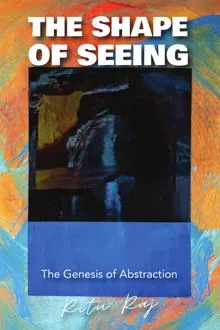 The companion bookThe Shape of SeeingThe Genesis of AbstractionHow abstraction arrives, and what happens when words run out. The painter’s side of the same inquiry.About the book →
The paintingsExplore the workMore than 250 paintings, each with its ArtGram. Organic Movement, Abstract Inquiry, and the collections in between.Enter the hive →