Something happened when you saw this. What was it?
Abstract Inquiry · 2026
Two Centers
Available · in the studio, Phoenix
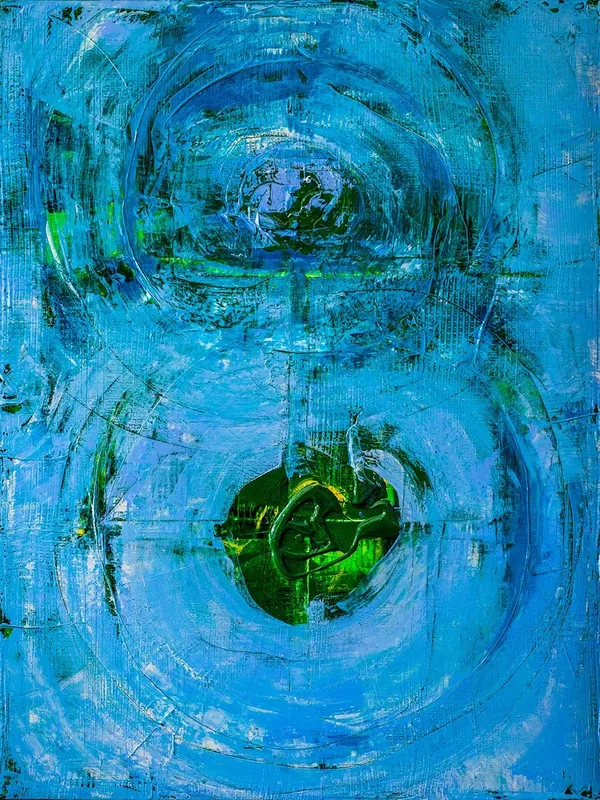
Two forces in permanent conversation — one dissolving, one generating — held together by the geometry of infinity.
There is a shape in mathematics that has no beginning and no end. The lemniscate — what most people call the infinity symbol — is not a decoration. It is a description of how two fields relate to each other when neither can exist without the other.
Two Centers began with that geometry. Not drawn. Felt.
The upper vortex came first — a cool blue-violet field spiraling inward, receding, dissolving into itself. There was something peaceful about it and something melancholy too. The kind of quiet that comes after something has finished. I let it develop without interference, watching the Cerulean and Cobalt Violet find their depth.
Then the lower field arrived and changed everything.
Electric green. Cadmium yellow at the core. Something cellular, almost embryonic — not placed but generated. Where the upper vortex was ending, the lower one was beginning. And between them, held in the neck of the figure-eight, a passage. Not a border. A conversation.
Four painters in the room
Wassily Kandinsky understood that abstract form carried spiritual weight before it carried aesthetic weight. His circles weren't decorations — they were cosmological arguments. The two vortex fields in Two Centers owe something to that conviction: that a form can hold meaning that language approaches but never quite reaches. The figure-eight is not a symbol here. It is a structure that thinks.
Hilma af Klint painted the invisible before abstraction had a name. Her large format works from the early twentieth century — the Paintings for the Temple series — positioned biological and spiritual forces in dialogue on the same canvas. The upper and lower fields of Two Centers exist in that same register: not illustrating duality but embodying it, asking the viewer to feel the difference between dissolution and generation rather than name it.
Lee Ufan has spent a career making work about the relationship between mark and space, presence and absence. His restrained touch always implies what is not there as much as what is. In Two Centers the blue ground is not background — it is active field, atmospheric and geological simultaneously. The vortices emerge from it rather than sitting on top of it. Ufan's philosophy of the encounter — the moment when viewer and work find each other — is what this painting is built for.
Yayoi Kusama returns obsessively to the dot, the loop, the net — forms that repeat until they become infinite. Her infinity rooms are environments of dissolution, designed to make the self permeable. Two Centers doesn't dissolve the self — it offers the self two positions simultaneously: the one that is ending and the one that is beginning. Where Kusama's infinity swallows, this painting holds the two states in productive tension.
What the painting is asking
Every painting in the Abstract Inquiry collection begins with a question I can't fully articulate. Two Centers began with something like: what is the shape of a transition?
Not the before. Not the after. The exact geometry of the passage between them.
The upper vortex knows what it was. The lower vortex doesn't yet know what it will become. Between them, in the narrow waist of the figure-eight, is the only moment that actually exists — the present, held in a shape that mathematics discovered and painting can make you feel.
This is a painting for rooms where thinking happens. For walls that you face when something in your life is moving from one state to another. The blue ground will hold the transition without rushing it. The green core will remind you that what is generating doesn't announce itself until it's ready.
Two Centers is acrylic on canvas, 36 × 48 inches, part of the Abstract Inquiry Collection.
Where to see it. In person at RituStudio, Phoenix, by appointment. Represented by Jarrow & Goodman, Los Angeles.
The space it needs
- Wall
- At least 4 ft wide
- Ceiling
- 8 ft or more
- Light
- Warm ambient or natural — the blue field deepens beautifully under both
- Daylight
- Works well near glass — the cool palette complements natural light and open views
Lives best in
Living room 5/5
Two Centers earns its place here because the figure-eight pull between the two cerulean vortices gives a living room exactly what it needs: something that changes as you move through the space and rewards the long look from the sofa.
Bedroom 4/5
The cool blue dominance and the mood of longing make this a painting you can live with in a quiet room, though the neon green accent carries just enough voltage to keep sleep from feeling invited.
Details
- Size
- 3 × 4 ft (W × H)
- Medium
- Acrylic on canvas
- Year
- 2026
- Collection
- Abstract Inquiry
- Palette
- Cerulean · Sea Blue · Cerulean · Cerulean · Forest Green · Forest Green · Jade Green · Neon Green · Jade Green
- Weight
- About 18 lb
- Ready
- In the studio; delivery Available now
Its ArtGram
ArtGram.Sprig
- Texture4
- Form2
- Colour range3
- Palette4
- Contrast1.9
- Abstraction Quotient4