Something happened when you saw this. What was it?
Abstract Inquiry · 2026
Sonoran Fire
Available · in the studio, Phoenix
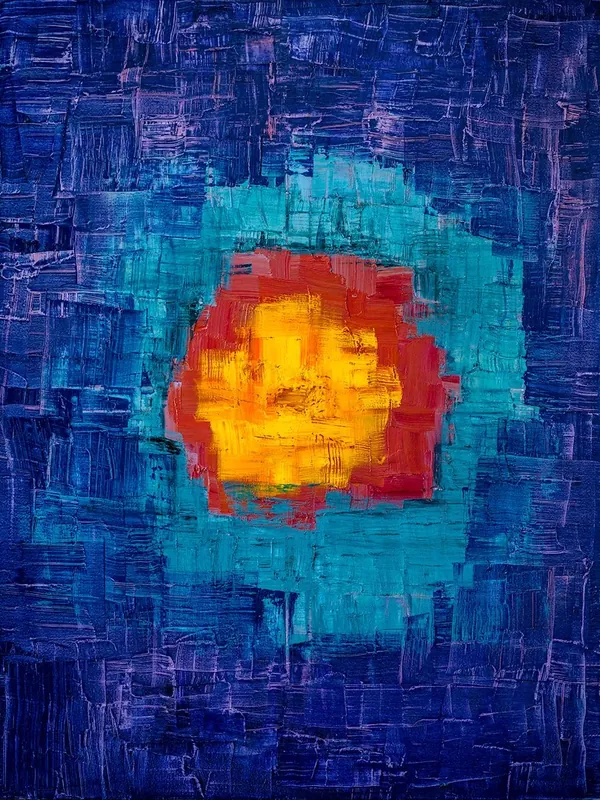
The most protected surface in the desert carries its most intense life at the center — this painting is that paradox, made permanent in oil.
I have been living in the Sonoran Desert for years now and I am still not used to what the cactus does in bloom.
The surface is hostile. Spines at every angle, skin like armor, a form designed entirely around the logic of protection. You don't approach a cactus carelessly. You keep your distance. You respect what it has built around itself.
And then it blooms. From the most defended surface in the desert, from the center of all that armor, comes a flower of such intensity — such chromatic ferocity, such concentrated life — that the protection suddenly reveals itself as something else entirely. Not defense. Sanctuary. The spine is not keeping the world out. It is keeping something precious in.
Sonoran Fire began with that inversion.
The crosshatch texture came first — palette knife work across the entire surface, building a skin that is woven and geological simultaneously. Deep indigo. The texture of something that has been in the desert for a long time. Then teal, worked into the crosshatch, building the middle field. Then the red began to arrive at the center, and finally the yellow-orange — cadmium and gold mixed until it glowed, until it felt like it was generating its own light rather than reflecting someone else's.
The painting took longer than I expected. Oil is patient. It doesn't dry overnight. It asks you to return to it over days, to add and subtract, to let each layer cure before the next one changes it. Sonoran Fire taught me something about that patience — about how the most concentrated things are the ones that take the longest to build.
Four painters in the room
Mark Rothko spent a career with nested fields — rectangles of color floating within rectangles of color, the boundaries between them soft and permeable, the whole surface vibrating with the relationship between what is inside and what surrounds it. Sonoran Fire is a Rothko conversation: concentric rather than stacked, but built on the same understanding that color relationships generate feeling that form alone cannot. Where Rothko's fields float, these are built. The texture makes them geological rather than atmospheric. But the emotional register is the same — the center as something that must be approached rather than seized.
Agnes Martin made work about the space between order and feeling — her grids and lines at the edge of perception, her surfaces that reward patient looking with something that arrives rather than announces itself. The crosshatch texture of Sonoran Fire operates in that register. From a distance it reads as field. Up close it reveals itself as structure — thousands of individual marks that together produce something none of them could produce alone. Martin would have understood that arithmetic.
J. Swaminathan — whose work I absorbed through my father's criticism of the Indian modernists — painted with a stillness that his surfaces barely contained. His work has a quality of discovery rather than declaration: the image not imposed but found, the painting revealing rather than asserting. Sonoran Fire was found in that sense. The center was not planned. It arrived through the process of building outward from indigo, and when the yellow-orange finally appeared it felt inevitable — as if it had always been there, waiting for the teal and red to give it permission to show itself.
Wolfgang Laib works with pollen — fields of it, accumulated grain by grain into surfaces of concentrated natural intensity. His work understands that the most powerful things are often the most delicate, that intensity and fragility are not opposites. The bloom at the center of Sonoran Fire has that quality. For all its chromatic force, it is surrounded by armor. The indigo protects it. The teal protects it. Even the red protects it. What you reach when you finally arrive at the center is something that required all of that to survive.
What the painting is asking
There is a thing the desert knows about survival that other landscapes don't. It is not about hardness. It is about concentration — about taking everything that might dissipate across a large surface and compressing it into a single point of intensity so powerful that nothing can extinguish it.
Sonoran Fire is that knowledge made permanent in oil.
This is a painting for bedrooms and quiet rooms — spaces where you want to feel held rather than stimulated, where the question is not what to do next but what you are protecting at your center. The indigo outer field will make the room feel grounded. The teal will open it slightly. And the yellow-orange at the core will give you something to return to, something that generates its own warmth regardless of the light in the room.
The cactus doesn't apologize for its spines. It knows what they're for.
Sonoran Fire is oil on canvas, 36 × 48 inches, part of the Abstract Inquiry Collection.
Where to see it. In person at RituStudio, Phoenix, by appointment. Represented by Jarrow & Goodman, Los Angeles.
The space it needs
- Wall
- At least 4 ft wide
- Ceiling
- 8 ft or more
- Light
- Warm ambient — the oil surface picks up warm light and the center glows
- Daylight
- Beautiful near glass in rooms with desert or garden views — the teal field echoes landscape
Lives best in
Living room 5/5
At 36 by 48 inches the nested fields change character through the day, cool and architectural in morning light, warm and glowing by evening, which is exactly the kind of slow shift a room you live in will actually notice.
Bedroom 5/5
The concentric structure draws the eye inward toward its warm center while the cool outer field of midnight blue and ultramarine holds everything still, a rhythm that settles rather than stimulates before sleep.
Details
- Size
- 3 × 4 ft (W × H)
- Medium
- Oil on canvas
- Year
- 2026
- Collection
- Abstract Inquiry
- Palette
- Midnight Blue · Cobalt · Ultramarine · Ultramarine Blue · Cobalt Teal · Cadmium Red · Cadmium Yellow · Indigo
- Weight
- About 22 lb
- Ready
- In the studio; delivery Available now
Its ArtGram
ArtGram.Corona
- Texture5
- Form3
- Colour range4
- Palette3.6
- Contrast4
- Abstraction Quotient3