Something happened when you saw this. What was it?
Abstract Inquiry · 2026
Sea Change
Available · in the studio, Phoenix
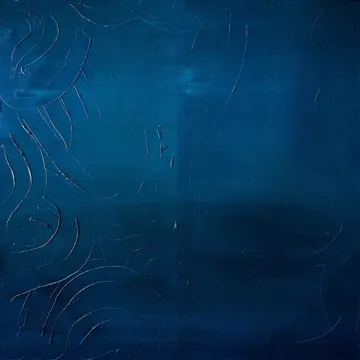
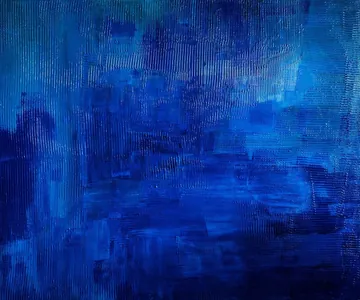
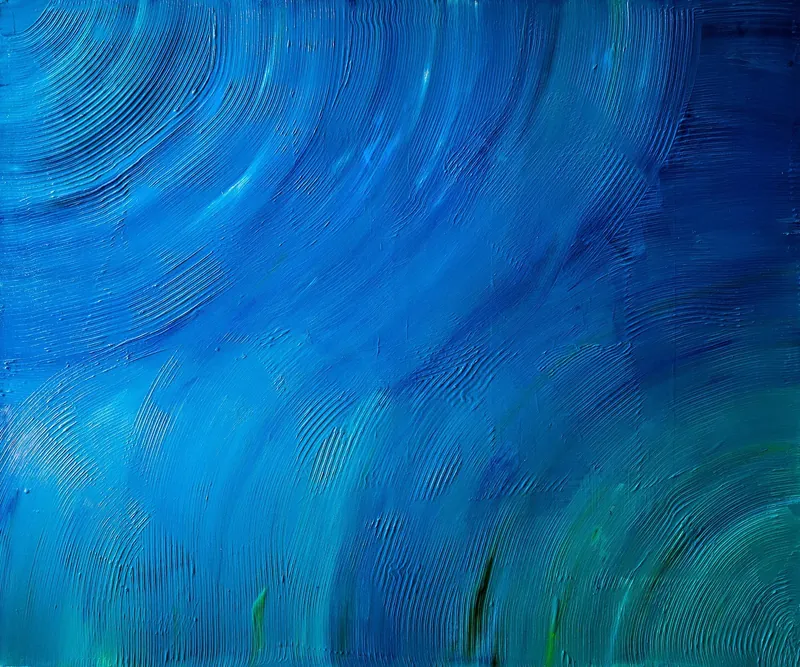
Weather moving across deep water, with green coming up from underneath rather than sitting on top.
It had been in the garage for three Phoenix summers. That is not storage. That is a slow test of whether a painting can survive being ignored in heat.
I was hunting. That is the word — I go looking for a canvas the way you look for prey, and I had been circling this one for a while. Industrial Whispers: Pipe, from 2024. Black and white, vertical, with a bold eighteen-inch black spine down it and a pipe coming off the spine. I liked it. Not enough.
It was framed, so one of my studio assistants took it out of the frame, and then it sat on the sawhorses for a couple of days doing nothing. I would come into the studio for a cold soda and stop and look at it on the way back out. Waiting. All that texture, all that power, and no reason yet.
Then, on a day I was leaving for Munds Park — my cabin, up in the hills — I decided to paint it blue. Which for me never means one blue. It means several, mixed into each other, laid down as ground. I built the background in oil and I used a little too much safflower oil, deliberately, to keep it from setting while I was gone.
Then I drove north, thinking about the whole thing the entire way. Monochrome black and white becoming monochrome blue.
It rained off and on. Coming back down, the hills stacked up in front of me in layers, each one a paler blue than the one before, and at the bottom of them the foliage came in green. Anyone who drives that road knows the desert is brown. It was not brown that day. It was a projection of blue, all the way down, with green at the floor of it.
I came home knowing exactly what I was going to do. I already had the blue ground. All that was left was to build the layers — dark blue receding into paler blue, ending in a green foreground. A landscape. I went at it on Monday.
It did not work.
I was unhappy with it in a way I do not often get. And the reason was underneath: the texture was against the grain. Those ridges were cut for a vertical painting with a black spine down the middle of it, and they had no interest whatsoever in being hills. Every layer I put down to make distance, the surface argued with. You cannot build recession on a topography that is running the wrong way.
There is a thing I have learned, and it saved this painting. There is nothing wrong in abstraction that is not fixed by more abstraction.
So I stopped trying to make hills. I kept moving the paint, pulling the blue across and over, diffusing the green until it stopped being foliage and became something else — colour arriving at the bottom of the canvas with no explanation attached to it.
It is not my landscape. It is my abstract blue field of a landscape, which is a different object.
Then I looked at it for two days. That is the part I cannot shorten. Two days of walking past it, and on the second one I knew — not that it was good, but that it had arrived. A new soul in an old body.
The green at the lower edge is the last of the hills. It is the only representational thing left in the painting, and it survived by being abstracted past the point of being recognisable.
The title is Shakespeare's. In The Tempest a body goes under and is not destroyed but changed — into coral, into pearl, into something rich and strange. The phrase has been worn smooth since, mostly by people announcing reorganisations. I want it back at the literal case, because the literal case is what this is: a painting that went under, and a landscape that went under after it.
Two things drowned here. Only one of them was a painting.
Where to see it. In person at RituStudio, Phoenix, by appointment. Represented by Jarrow & Goodman, Los Angeles.
The space it needs
- Wall
- At least 8 ft wide
- Ceiling
- 9 ft or more
- Light
- Cool or neutral light keeps the blues true; warm bulbs push the field toward gray. Side light brings the combing forward.
- Daylight
- Holds up well in strong daylight — the cool palette does not shift the way warm work does under Arizona sun
Lives best in
Living room 5/5
Sea Change earns the full five here: six feet of cobalt and malachite at conversation height turns the living room wall into a slow tide, and the impasto ridges read differently from every seat in the room.
Bedroom 5/5
The submersion palette, cool blue running into deep malachite, does exactly what a bedroom needs, pulling the eye inward and slowing the breath without sending the room toward melancholy.
Details
- Size
- 6 × 5 ft (W × H)
- Medium
- Oil on canvas
- Year
- 2026
- Collection
- Abstract Inquiry
- Palette
- Sea Blue · Cerulean · Cobalt · Malachite Green
- Weight
- About 46 lb
- Ready
- In the studio; delivery 8–10 weeks
- Painted over
- Industrial Whispers, still there underneath
Its ArtGram
ArtGram.Sprig
- Texture5
- Form3
- Colour range3
- Palette4.4
- Contrast1.6
- Abstraction Quotient5