Something happened when you saw this. What was it?
Organic Movement · 2025
Self Remembering Itself
Available · in the studio, Phoenix
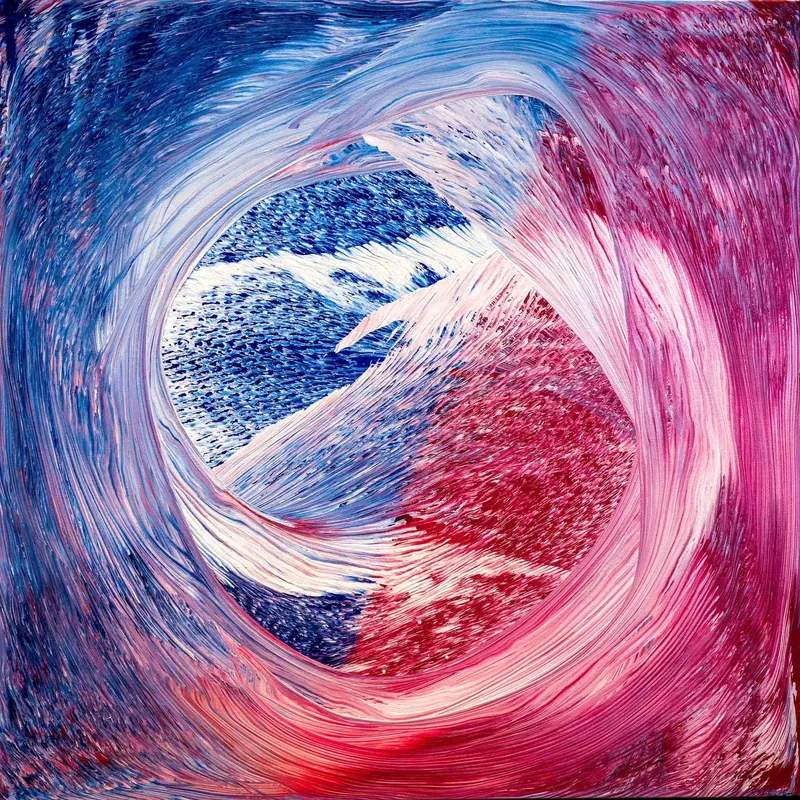
Crimson turning inward — the self as subject, red as the color of the memory that has nowhere else to go.
Self Remembering Itself explores organic movement as an act of return. The painting is structured around a circular, spiraling motion—an inward sweep of blue, crimson, and white that suggests both turbulence and coherence. The surface feels in motion, yet anchored, as if the energy of the painting is folding back upon itself rather than dispersing outward.
This work is less about expression than recollection. The gestures curve, overlap, and re-enter their own paths, creating a sense of continuity rather than progression. Movement here is not linear or goal-oriented; it is recursive. The painting behaves like memory itself—layered, nonlinear, and embodied. Each brushstroke holds the trace of a previous moment while reshaping what follows.
The tension between cool blues and warm reds establishes a dynamic internal dialogue. These colors do not oppose each other; they interpenetrate, forming a dense field of interaction. The central opening—neither void nor focal point—acts as a pause where motion briefly suspends, allowing awareness to gather. It is in this pause that the painting’s title becomes felt rather than read.
At a 3 × 3 ft scale, Self Remembering Itself invites an intimate encounter. The viewer’s eye is drawn into the circular motion, following the sweep of the brush as if tracing a thought returning to its origin. The painting does not present an image of the self; it enacts a process of self-recognition through movement.
Influences include the late works of Willem de Kooning, particularly his ability to sustain tension between gesture and structure, and Gerhard Richter’s exploration of how surface manipulation can function as a form of thinking. Mark Rothko’s understanding of color as a field of presence rather than representation also resonates here, especially in the way color operates emotionally rather than symbolically. From Indian modernism, J. Swaminathan’s conception of abstraction as an inner orientation rather than an external depiction continues to inform the work.
Self Remembering Itself belongs to an ongoing inquiry into abstraction as a site of consciousness. The painting does not aim to be decoded. Instead, it offers a space where perception, memory, and sensation converge—where the self briefly encounters itself in motion.
Where to see it. In person at RituStudio, Phoenix, by appointment. Represented by Jarrow & Goodman, Los Angeles.
The space it needs
- Wall
- At least 5 ft wide
- Ceiling
- 8 ft or more
- Light
- Warm ambient light enhances organic palette — thread catches light beautifully
- Daylight
- The ultramarine and cerulean hold steady near a window, but the magenta undertone warms under west afternoon sun. An east wall keeps the two in balance, and side light lifts the thread ridges.
Lives best in
Bedroom 5/5
The magenta undertone warming beneath silver and shadow blue, the thread catching soft ambient light, the circular motion that folds back on itself rather than pushing outward: all of this makes the painting precisely the right companion for a room built around rest and reflection.
Living room 4/5
At three feet square, Self Remembering Itself earns its place on a living room wall by rewarding the kind of unhurried looking that a shared room allows, its cerulean and ultramarine loops pulling the eye inward while the stitched thread catches lamplight and shifts across an evening.
Details
- Size
- 3 × 3 ft (W × H)
- Medium
- Oil on canvas with thread
- Year
- 2025
- Collection
- Organic Movement
- Palette
- Muted White · Magenta Undertone · Tarnished Silver · Shadow Blue · Ultramarine · Cerulean
- Weight
- About 22 lb
- Ready
- In the studio; delivery 6–10 weeks
Its ArtGram
ArtGram.Fork
- Texture3
- Form2
- Colour range3
- Palette4.2
- Contrast4
- Abstraction Quotient0