Journal · Geometry, Technology & Science
String Wave: The Mathematics Behind Motion, Texture, and Light
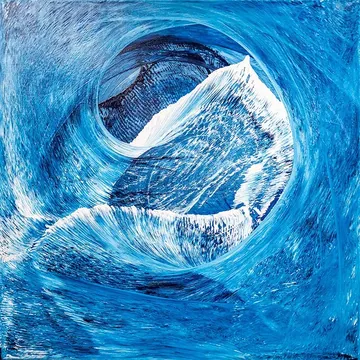
Ritu Raj’s String Wave reveals how abstraction, physics, and texture converge. Built on a mathematical model of swirling fields and vibrating strings, the painting transforms motion into light.
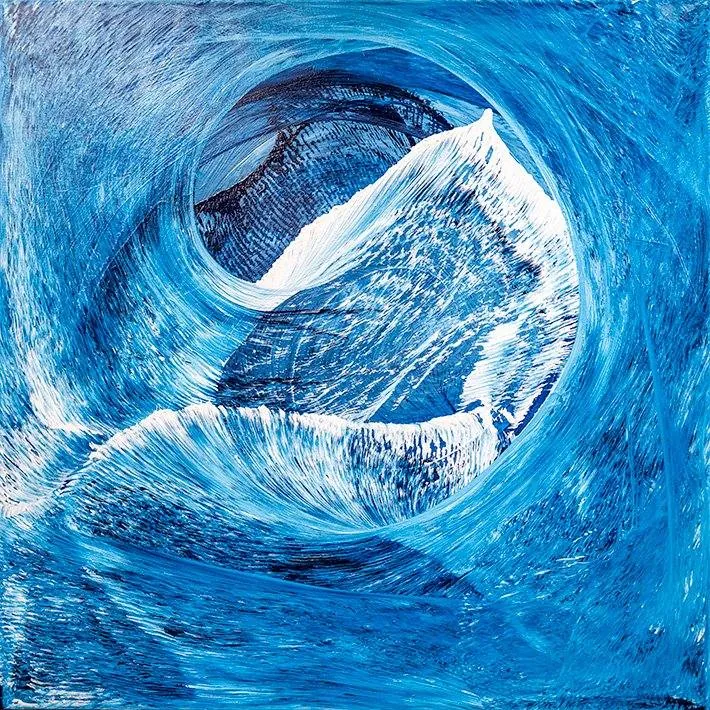
String Wave emerges from an encounter between intuition and mathematics—a painting made with a single sweeping tool, yet supported by a hidden architecture drawn from fluid dynamics and wave theory. While the gesture appears effortless, the form it produces can be described precisely: a swirl shaped by a vector field, a crest defined by vibrating strings, and textures created by pigment density over time.
The foundation of the composition is a vortex-like vector field—a simplified mathematical model of how water or air moves as it spirals around a center. If we imagine the canvas as the square domain
(x,y)∈[−1,1]×[−1,1],(x,y)\in[-1,1]\times[-1,1],(x,y)∈[−1,1]×[−1,1],
each stroke follows an integral line of the field:
dΓds=F(Γ(s)),\frac{d\Gamma}{ds}=\mathbf{F}(\Gamma(s)),dsdΓ=F(Γ(s)),
where F(x,y)\mathbf{F}(x,y)F(x,y) is a swirling function that causes directional curvature. This field bends the strokes into sweeping arcs, giving String Wave its characteristic sense of rotation, gravity, and pull. The motion is not random—it is mathematically predictable, but emotionally alive.
Along these arcs lies the second layer of the model: vibrating strings. Each path behaves like a one-dimensional wave, governed by
w(s)=A(s)sin(2πλs+ϕ),w(s)=A(s)\sin\left(\frac{2\pi}{\lambda}s+\phi\right),w(s)=A(s)sin(λ2πs+ϕ),
with amplitude A(s)A(s)A(s) peaking dramatically near the crest. Where waves overlap, pigment density increases and deep cobalt blues form. Where vibration reaches its maximum, the energy effectively “wipes” the surface clean, revealing the bright white ridge. This is the envelope of maximum vibration—the mathematical point at which oscillation becomes illumination.
To translate these motions into visual form, the painting uses a pigment-density function derived from the distance between each point on the canvas and the vibrating string network. When many waves pass near a point, pigment accumulates; when the waves diverge or reach high amplitude, pigment clears. This creates the richly textured transitions—sometimes dense and stormy, sometimes feathered and light—that define the work’s atmosphere.
In String Wave, art and mathematics do not contradict one another. They cooperate. The gesture of the hand activates the system; the system amplifies the gesture. What results is an image of motion suspended in stillness, where the underlying equations become visible not as numbers, but as energy, structure, and luminous form.
Wall Text
String Wave is built on a mathematical model inspired by the physics of vibrating strings and the swirling motion of fluid flow. The curved forms arise from a vortex-like field that bends thousands of fine “string paths” across the canvas, each carrying a subtle wave pattern defined by its amplitude and rhythm. Where these vibrations converge, pigment accumulates into deep blues; where their energy peaks, the motion erases itself, revealing the bright white crest. This fusion of chaos, order, and motion gives String Wave its living, mathematical elegance.
Full Mathematical Model for String Wave
1. The canvas as a domain
Take the painting as the square domain
(x,y)∈[−1,1]×[−1,1].(x,y)\in[-1,1]\times[-1,1].(x,y)∈[−1,1]×[−1,1].
Background = white.
2. Swirling “flow” that bends the strings
We define a vector field that makes everything curve like a wave rolling around an eye:
Let the swirl centre be at the left of the circle,
c=(cx,cy)=(−0.2,0).c=(c_x,c_y)=(-0.2,0).c=(cx,cy)=(−0.2,0).
Define
r2=(x−cx)2+(y−cy)2.r^2=(x-c_x)^2+(y-c_y)^2.r2=(x−cx)2+(y−cy)2.
A simple swirling field:
F(x,y)=(u(x,y),v(x,y))\mathbf{F}(x,y)=(u(x,y),v(x,y))F(x,y)=(u(x,y),v(x,y))
with
u(x,y)=−(y−cy) e−r2/σ2,u(x,y)=-(y-c_y)\,e^{-r^2/\sigma^2},u(x,y)=−(y−cy)e−r2/σ2,v(x,y)=(x−cx) e−r2/σ2,v(x,y)=(x-c_x)\,e^{-r^2/\sigma^2},v(x,y)=(x−cx)e−r2/σ2,
where σ\sigmaσ controls how wide the swirl is.
The integral curves of this field (solutions of
dΓds=F(Γ(s))\frac{d\Gamma}{ds}=\mathbf{F}(\Gamma(s))dsdΓ=F(Γ(s))) are the big curved paths you see: the outer blue arc and the funnel-like inner tunnel.
Call each such curve a string path Γk(s)\Gamma_k(s)Γk(s).
3. Strings carrying waves (the “string wave” idea)
Along each path Γk(s)\Gamma_k(s)Γk(s) we place a 1-D vibrating string.
Take arc-length sss along the k-th curve. At a frozen “time” t0t_0t0 the transverse displacement of the string is
wk(s)=Ak(s) sin (2πλks+ϕk),w_k(s)=A_k(s)\,\sin\!\left(\frac{2\pi}{\lambda_k}s+\phi_k\right),wk(s)=Ak(s)sin(λk2πs+ϕk),
λk\lambda_kλk – local wavelength (shorter near the crest where the texture is dense).
ϕk\phi_kϕk – phase shift for each string.
Ak(s)A_k(s)Ak(s) – a smooth amplitude that is largest near the bright white crest, smaller elsewhere.
We don’t actually move the canvas; we just encode paint density with this wave.
4. From string displacement to paint marks
At every point near a curve Γk(s)\Gamma_k(s)Γk(s) we define a distance to the displaced string:
Let Tk(s)\mathbf{T}_k(s)Tk(s) be the unit tangent of Γk\Gamma_kΓk and Nk(s)\mathbf{N}_k(s)Nk(s) the unit normal.
The geometric location of the vibrating string in the plane is
Sk(s)=Γk(s)+wk(s) Nk(s).\mathbf{S}_k(s)=\Gamma_k(s)+w_k(s)\,\mathbf{N}_k(s).Sk(s)=Γk(s)+wk(s)Nk(s).
For any point (x,y)(x,y)(x,y), define its distance to the k-th string as
dk(x,y)=mins∥ (x,y)−Sk(s) ∥.d_k(x,y)=\min_s \big\|\,(x,y)-\mathbf{S}_k(s)\,\big\|.dk(x,y)=smin(x,y)−Sk(s).
The pigment density at (x,y)(x,y)(x,y) is then
P(x,y)=∑kexp (−dk(x,y)2ε2),P(x,y)=\sum_k \exp\!\left(-\frac{d_k(x,y)^2}{\varepsilon^2}\right),P(x,y)=k∑exp(−ε2dk(x,y)2),
with ε\varepsilonε setting the thickness of the “string” marks. Where many strings pass close together (like at the base and tip of the crest), PPP is high ⇒ dense blue.
5. The sharp white–blue wave crest
To emphasize the crest, choose the amplitudes Ak(s)A_k(s)Ak(s) and wavelengths λk\lambda_kλk so that:
for strings whose paths lie under the crest region,
Ak(s)A_k(s)Ak(s) peaks on a curve that looks like a mountain edge:s∈Ck⇒Ak(s)≈Amax,else Ak(s) smaller.s \in C_k \Rightarrow A_k(s)\approx A_{\max},\quad \text{else } A_k(s)\text{ smaller}.s∈Ck⇒Ak(s)≈Amax,else Ak(s) smaller.
λk\lambda_kλk decreases near that same region (shorter waves → tighter, whiter texture).
Where the oscillations are so large that the string “scrapes away” pigment, you set:
P(x,y)≈0(pure white ridge).P(x,y)\approx 0 \quad \text{(pure white ridge)}.P(x,y)≈0(pure white ridge).
So the bright triangular peak is literally the envelope of maximum oscillation of many strings.
6. Color mapping
Use pigment density to pick blue vs white:
BlueIntensity(x,y)=clamp(αP(x,y), 0,1).\text{BlueIntensity}(x,y) = \mathrm{clamp}\big(\alpha P(x,y),\,0,1\big).BlueIntensity(x,y)=clamp(αP(x,y),0,1).
Then define RGB, for example,
R(x,y)=1−BlueIntensity(x,y),R(x,y)=1-\text{BlueIntensity}(x,y),R(x,y)=1−BlueIntensity(x,y),G(x,y)=1−BlueIntensity(x,y),G(x,y)=1-\text{BlueIntensity}(x,y),G(x,y)=1−BlueIntensity(x,y),B(x,y)=1,B(x,y)=1,B(x,y)=1,
so low density ⇒ nearly white, high density ⇒ deep blue.
In words
The swirl comes from a vortex-like vector field.
The fine string textures are 1-D wave equations laid along those flow lines.
The wave crest is the region where the amplitude envelope of many strings peaks and pigment density both increases (dark band) and then drops to zero (white edge).
Paintings in this essay
Keep reading