Something happened when you saw this. What was it?
Organic Movement · 2025
Wound That Thinks
Available · in the studio, Phoenix
The wound as intelligence — thread as the mark of something that knows exactly what happened to it and is still processing.
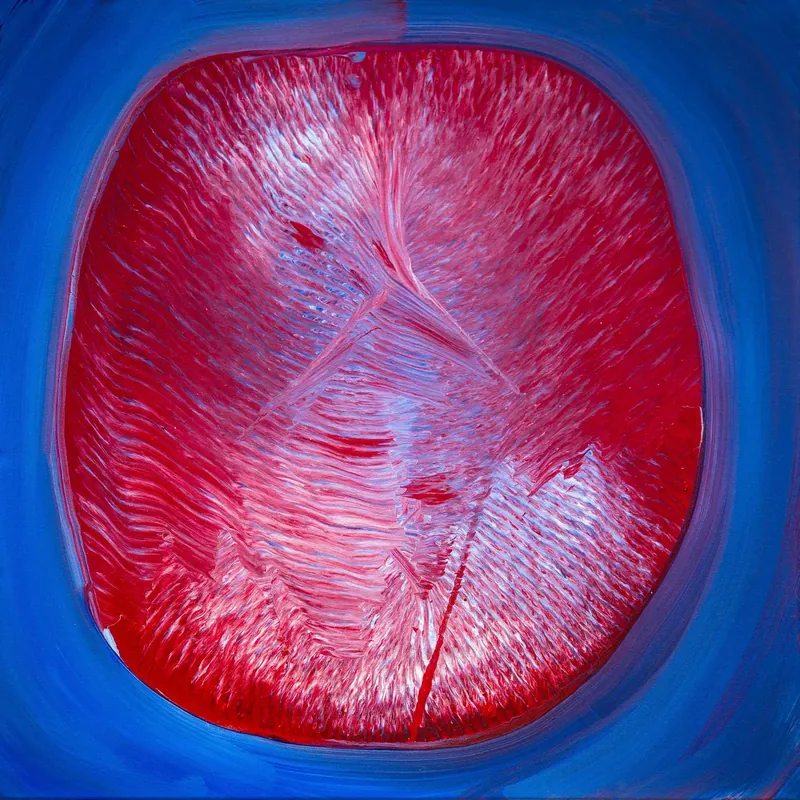
Wound That Thinks is a 2 x 2 ft abstract painting that explores organic movement as both a physical and cognitive force. The work emerges from a process-driven approach, where gesture, pressure, and resistance shape the final form. Rather than depicting a wound as a literal injury, the painting treats it as a site of awareness—something that feels, reacts, and thinks.
The dominant red field carries a visceral intensity. Its striated surface suggests flesh, erosion, and time passing through matter. These marks are not decorative; they are records of movement, created through repeated actions that build tension and release across the surface. The paint behaves almost autonomously, forming ridges and directional flows that echo biological systems—muscle fibers, neural pathways, scar tissue.
Surrounding this red mass is a cool blue field that stabilizes and contains the composition. The blue acts as both boundary and counterpoint, creating a psychological distance that allows the viewer to contemplate the intensity within. This interplay between red and blue mirrors the dialogue between sensation and reflection, instinct and thought.
The triangular convergence at the center introduces a sense of structural thought—an internal geometry struggling to emerge from organic chaos. This tension between form and formlessness reflects my ongoing interest in how consciousness organizes itself around rupture and uncertainty.
The painting is influenced by artists who treat abstraction as a philosophical inquiry rather than a purely aesthetic one. Mark Rothko’s use of color as an emotional field, Barnett Newman’s focus on existential presence, and Clyfford Still’s raw, tectonic surfaces all inform the work. From Indian modernism, the influence of J. Swaminathan’s elemental abstraction and F.N. Souza’s psychological intensity can be felt in the painting’s refusal to resolve into comfort.
Wound That Thinks invites slow looking. It is less about what is seen immediately and more about how the body and mind respond over time—how abstraction can hold sensation, memory, and thought in a single, concentrated form.
Where to see it. In person at RituStudio, Phoenix, by appointment. Represented by Jarrow & Goodman, Los Angeles.
The space it needs
- Wall
- At least 3 ft wide
- Ceiling
- 7 ft or more
- Light
- Warm ambient light enhances organic palette — thread catches light beautifully
- Daylight
- Carmine warms in western afternoon sun while the cobalt and ultramarine hold, and at contrast this low direct light can wash the wound flat. A small painting for a north wall or a shaded corner near a window.
Lives best in
Bedroom 5/5
This is exactly the right scale and temperature for a bedroom: the magenta undertone warms the dark, the raised thread rewards quiet looking, and the theme of consciousness gathering around rupture fits the half-awake hour better than almost anywhere else.
Living room 4/5
Wound That Thinks rewards a living room where people linger: the carmine rupture at its center draws the eye slowly inward, and the thread caught in warm ambient light gives the 2×2 canvas a presence larger than its footprint.
Details
- Size
- 2 × 2 ft (W × H)
- Medium
- Oil on canvas with thread
- Year
- 2025
- Collection
- Organic Movement
- Palette
- Carmine · Cobalt · Ultramarine · Magenta Undertone
- Weight
- About 10 lb
- Ready
- In the studio; delivery 6–10 weeks
Its ArtGram
ArtGram.Spur
- Texture3
- Form2
- Colour range2
- Palette4
- Contrast1.3
- Abstraction Quotient0