Something happened when you saw this. What was it?
Organic Movement · 2025
Passage Into Presence
Available · in the studio, Phoenix
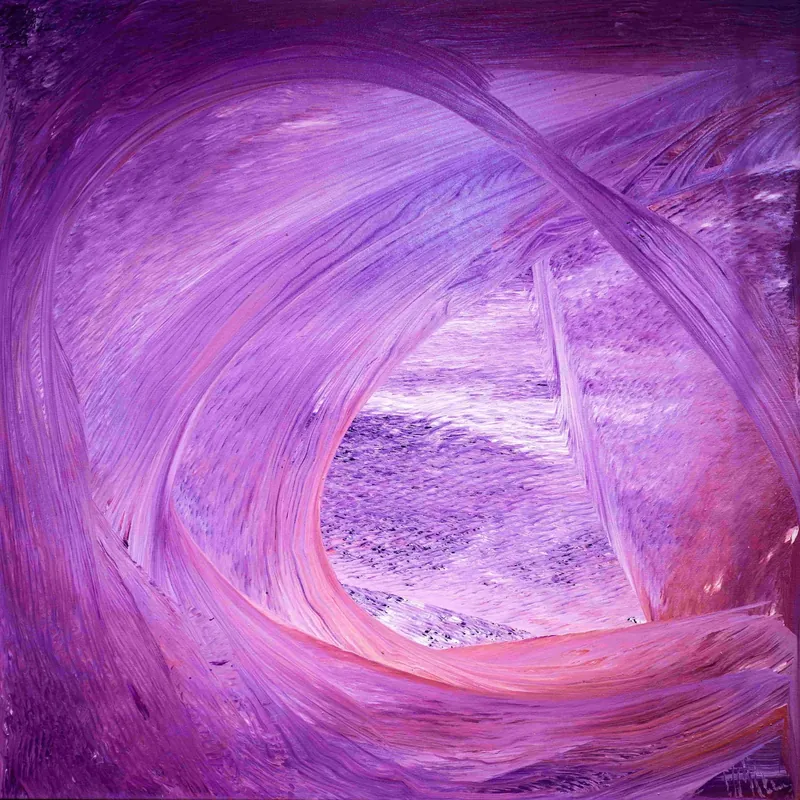
The passage is the painting — thread marking the transition between one state of being and something more fully present.
Passage Into Presence is an exploration of movement as transition rather than direction. The painting opens into a curved, flowing passage—an interior corridor formed not by architecture, but by gesture. Layers of violet, lavender, and soft rose sweep across the surface, creating a sense of entering rather than observing, of being drawn inward rather than standing outside the image.
The composition suggests motion without destination. Brushstrokes arc and fold over one another, generating a spatial rhythm that feels both enveloping and intimate. The central opening is not a void but a luminous pause—an interval where movement briefly gathers itself. This is not a tunnel toward resolution, but a moment of heightened awareness, where attention turns inward and presence becomes palpable.
Organic movement here is not decorative; it is structural. Each stroke records pressure, speed, hesitation, and release. The surface carries the memory of its making, allowing the viewer to trace the painting’s evolution through time. From a distance, the work reads as a unified flow. Up close, it reveals countless micro-decisions—small adjustments that collectively create depth and coherence.
At a 3 × 3 ft scale, Passage Into Presence invites a bodily relationship. The viewer’s eye moves along the curves instinctively, mirroring the gestures that formed them. This physical resonance is central to the work. The painting does not describe presence; it attempts to enact it.
Influences here include the spatial tension of Mark Rothko’s later color fields, where color becomes an environment rather than an image, and the gestural intelligence of Willem de Kooning, whose marks retain a sense of struggle and immediacy. There is also a quieter dialogue with artists like Gerhard Richter, particularly in the way surface manipulation becomes a form of thinking. From Indian modernism, J. Swaminathan’s understanding of abstraction as a space for inner orientation rather than representation continues to inform the work.
Passage Into Presence reflects an ongoing inquiry into how abstraction can function as an experiential threshold. Rather than offering symbolism or narrative, the painting asks for attention—slow, embodied, and receptive. Meaning arises not through interpretation, but through sustained looking.
Where to see it. In person at RituStudio, Phoenix, by appointment. Represented by Jarrow & Goodman, Los Angeles.
The space it needs
- Wall
- At least 5 ft wide
- Ceiling
- 8 ft or more
- Light
- Warm ambient light enhances organic palette — thread catches light beautifully
- Daylight
- Lavender and plum sit between warm and cool, and they hold fairly even through the day. Strong direct sun pales the soft lilac; a raking angle instead lights the thread passes running through the corridor.
Lives best in
Bedroom 5/5
A 5 without reservation: the lilac and plum palette, the luminous stillness, and the thread that catches warm ambient light all work exactly as a painting should work above a bed, quieting the room without emptying it.
Living room 4/5
Passage Into Presence earns a 4 here because its lavender-to-plum gradient and stitched thread details reward the slower, closer looking that a living room allows, though the 3×3 ft scale leaves it slightly understated on any wall longer than ten feet.
Details
- Size
- 3 × 3 ft (W × H)
- Medium
- Oil on canvas with thread
- Year
- 2025
- Collection
- Organic Movement
- Palette
- Lavender · Soft Lilac · Plum · Deep Purple
- Weight
- About 22 lb
- Ready
- In the studio; delivery 6–10 weeks
Its ArtGram
ArtGram.Fork
- Texture3
- Form2
- Colour range2
- Palette4
- Contrast3.5
- Abstraction Quotient0