Something happened when you saw this. What was it?
Abstract Inquiry · 2026
Mapping the Unseen
Lines of Inquiry in Color and Form
Available · in the studio, Phoenix
Lines of inquiry in color and form — the map that charts what cannot otherwise be located, cartography of the unseen.
Every map begins as a question about where you are.
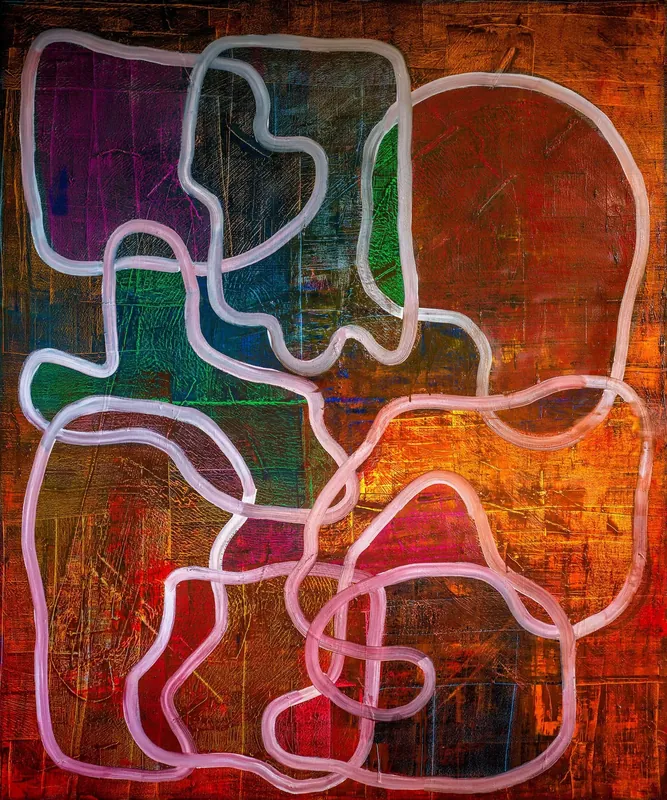
Mapping the Unseen opens with color fields that appear, at first, to have settled: deep reds, burnt oranges, greens, and violets layered over a textured ground that carries the evidence of its own making. There is a sense of territory here. Boundaries that seem established.
Then the white line enters, and nothing stays settled.
It doesn't describe a shape. It doesn't arrive at a destination. It moves — wandering, looping, crossing boundaries it helped create, connecting areas that had no reason to speak to each other. It is less a compositional element than a mind in motion. A thought that keeps revising itself as it travels. The line is the inquiry; everything else is the terrain it moves through.
Beneath the color fields, a grid-like texture holds its ground — the suggestion of systems, of structure, of something that wanted to be ordered. The line resists all of it. It bends where the grid insists on straight. It improvises where the surface demands control. This tension — between the architecture underneath and the movement on top — is where the painting lives.
Oil made this possible. Working slowly, layer by layer, each passage builds depth that is temporal as much as visual. The surface holds what happened before: scraped areas, redirections, reworked passages where the painting changed its mind. You're not looking at a finished decision. You're looking at the record of thinking.
Picasso's fragmentation and reassembly of form is an ancestor here — the idea that breaking structure open reveals more than preserving it. Basquiat's instinctive line, urgent and loaded with meaning, informs the white line's authority. Richter's layered ambiguity lives in the surface. De Kooning's negotiation between gesture and structure runs through the whole composition. And Swaminathan — the understanding that abstraction doesn't abandon natural systems, it distills them.
This painting doesn't conclude. Every line is a thought mid-sentence. Every intersection, an opening.
Where to see it. In person at RituStudio, Phoenix, by appointment. Represented by Jarrow & Goodman, Los Angeles.
The space it needs
- Wall
- At least 8 ft wide
- Ceiling
- 9 ft or more
- Light
- Natural light preferred — oil layers shift through the day
- Daylight
- Strong contrast keeps the lines legible near a window. Prussian blue and graphite hold, while citrine and copper warm through the afternoon; east or north light keeps the map's colors where they were placed.
Lives best in
Living room 5/5
At 5 × 6 ft, the wandering white lines and copper-warm undertones give a living room the rare quality of a painting that repays long acquaintance, revealing new mid-sentence marks each time the light shifts.
Hotel lobby 4/5
The burnt umber and Prussian blue hold the eye at lobby scale without demanding stillness, and the defiant grid-breaking improvisation signals intellectual ambition to a passing guest who will never see it twice.
Details
- Size
- 5 × 6 ft (W × H)
- Medium
- Oil on canvas
- Year
- 2026
- Collection
- Abstract Inquiry
- Palette
- Burnt Umber · Graphite Black · Deep Madder · Copper · Prussian Blue · Buttery Yellow · Muted White · Citrine Yellow
- Weight
- About 45 lb
- Ready
- In the studio; delivery 8–12 weeks
Its ArtGram
ArtGram.Sprig
- Texture3
- Form3
- Colour range4
- Palette2.3
- Contrast4.3
- Abstraction Quotient3.5