Journal · Studio Voice & Philosophy
Modern Abstract Artist in Phoenix: One Obsession, Two Materials
I build things that scale. I paint things that can’t.
What I build, and what I paint
For three decades I have built companies that changed industries. Avasta helped pioneer cloud computing. SideCar launched the ride-sharing model before Uber or Lyft. Wag Hotels became the largest dog hotel chain in the world. Diamond Foundry grew to become the world's largest producer of lab-grown diamonds.
I don't lead with these because they're impressive. I lead with them because they come from the same place the paintings do.
Since 2020, painting has been the center of my days. Not as a hobby. Not as a side project. As the thing.
Growing up inside Indian modernism
My father, K.B. Goel, was one of India's preeminent art critics — a man who championed artists like Souza, Husain, and Swaminathan when they were still arguing with each other about what Indian modernity meant. I grew up in New Delhi with paintings on the walls and arguments about art at the table.
I absorbed a particular kind of looking — one that took abstraction seriously as a philosophical practice, not just an aesthetic one. I didn't know at the time how deep that absorption had gone. It ran under every company I built, and it runs through every canvas now.
What abstraction asks that building does not
The companies I build are about scale, repeatability, systems that can grow beyond any single person's involvement. That's a particular kind of intelligence — useful, rigorous, and almost the opposite of what painting asks for.
A painting can't scale. It exists once, in one place, made by one pair of hands on one afternoon. It doesn't optimize. It doesn't iterate toward a product-market fit. It either arrives or it doesn't, and the only way to know is to be present for the whole of it.
I find that discipline — the discipline of presence, of undivided attention, of making something that resists reproduction — as demanding as anything I have built. And as necessary.
Phoenix as a place for this kind of work
I work from RituStudio, an 1,800 square foot studio and gallery in Phoenix. People ask sometimes why Phoenix — why not New York, why not Los Angeles, why not somewhere with a more established contemporary art scene.
I think Phoenix is exactly right for this work. There's a quality of light here that's almost aggressive — desert light, unfiltered, which makes color decisions immediate and consequential. And there's a culture of building without permission, of not waiting for an institution to validate what you're making, that suits the way I work.
My gallery representation is with Jarrow & Goodman in Los Angeles. My collectors are across the US, Europe, and Asia. Phoenix is where the work gets made — which is the only part that actually matters.
What I make, and why
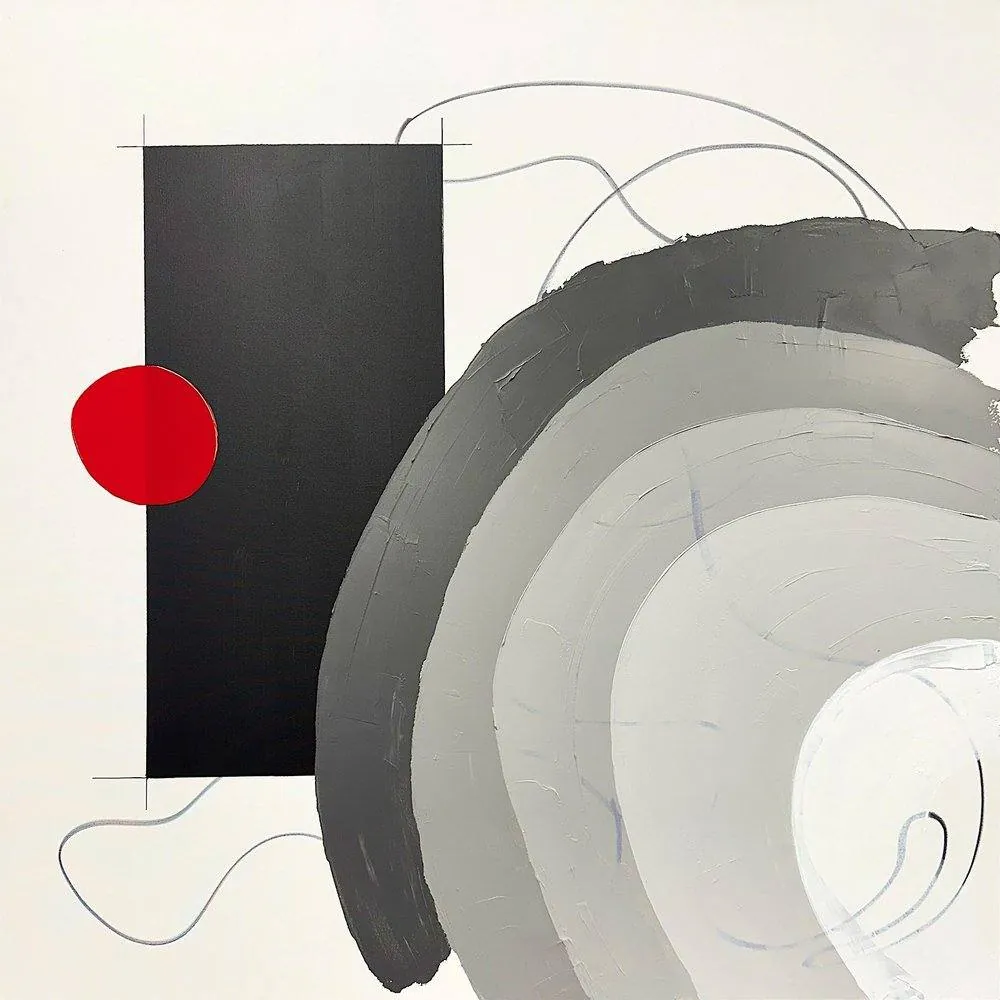
My work divides into two bodies. The first, Organic Movement, involves thread, gravity, and viscosity — making in which I set conditions and release control, letting the material make decisions I couldn't have predicted. The second, Abstract Inquiry, involves oil and acrylic on canvas — listening to a painting over days or weeks until it says it's done.
Both practices are, at their core, about the same thing: what happens when a human being pays full, patient attention to something that doesn't have words. I build businesses that are very good at words. Painting is where I go for what lives outside of them.
I'm represented by Jarrow & Goodman in Los Angeles and have exhibited at the LA Art Show and Scottsdale Art Week.
If you're new to my work, start with the Organic Movement collection or the Abstract Inquiry collection — or read about how these two approaches to painting require completely different kinds of surrender.